Categories
Latest blog
Why Are More Hotels Replacing Traditional Locks with Smart Lock Systems?
For many hotels, door locks used to be a simple hardware decision. Today, they are part of guest experience, staff workflow, security management, and property operations.
Traditional keys and older magnetic-card locks can still open a door, but they often create problems that modern hospitality teams cannot ignore: lost keys, copied credentials, limited access visibility, slow replacement procedures, and inefficient staff access management.
That is why more properties are upgrading to smart hotel lock systems. The goal is not simply to make doors look more modern. It is to create a more controlled, flexible, and scalable access experience for guests, staff, and managers.
A physical key is difficult to control once it leaves the front desk. It can be lost, duplicated, returned late, or kept by a former guest or employee. Re-keying a lock after a lost key can also add unnecessary cost and operational disruption.
Older access systems may create another challenge: limited visibility. When a guest reports a security concern, hotel teams need to understand who had access, when access occurred, and whether a credential should be canceled immediately. Traditional mechanical locks cannot provide this level of information.
Hotels also manage far more than guest-room doors. Housekeeping staff, maintenance teams, managers, contractors, public-area users, and guests may all need different levels of access. Managing those permissions with physical keys can quickly become complicated.
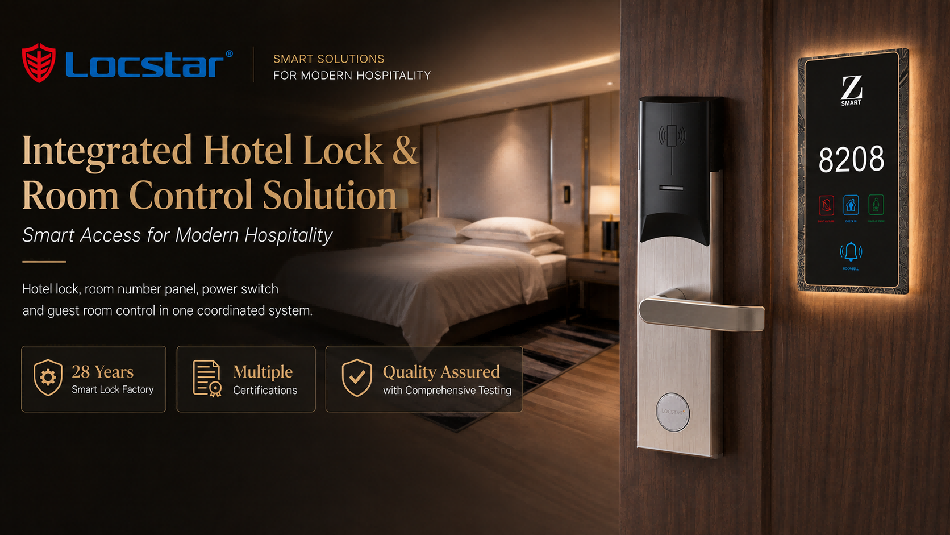
A smart hotel lock system is more than a single electronic door lock. It is a connected access solution that can include hotel locks, RFID cards, card encoders, management software, energy-saving switches, doorplates, access-control readers, and elevator-control devices.
Depending on the project, guests may use RFID cards, mobile credentials, PIN codes, fingerprints, or other approved access methods. Staff can receive role-based access rights, while management can define when and where each credential works.
Feature availability varies by lock model and system configuration, so hotels should always confirm technical requirements before selecting a solution.
| Area | Traditional Keys or Older Locks | Smart Hotel Lock Systems |
| Guest access | Physical key or basic card | RFID card, mobile credential, PIN, or other approved methods |
| Lost-key response | Re-key or replace lock hardware | Cancel, expire, or replace the credential |
| Staff permissions | Multiple physical keys to manage | Role-based access by department or area |
| Access records | Usually unavailable | Audit records may be available through compatible systems |
| Checkout control | Keys may not be returned promptly | Time-limited credentials can expire after checkout |
| Public-area access | Separate keys and manual management | Can be planned with shared access-control rules |
| Energy management | Manual room power control | Optional card-based energy saver integration |
| Property expansion | More keys and more complexity | Modular access planning for rooms and common areas |
Smart lock systems make it easier to manage who can enter a room or area. A guest credential can be assigned to a specific room and stay period. Staff credentials can be restricted to approved floors, rooms, or back-of-house areas.
This helps hotels reduce the uncertainty created by lost keys, unauthorized duplicates, and uncontrolled master-key circulation.
Guests expect check-in to be simple. RFID hotel locks can support a familiar card-based experience, while selected smart-lock systems may offer additional access options.
Instead of searching for physical keys, guests receive a programmed credential that is ready for their stay. This can help front-desk teams manage busy arrival periods more efficiently.
Housekeeping, maintenance, security, and management teams do not need the same level of access. A well-planned hotel lock system allows properties to define access by role, location, and time.
For example, a maintenance credential may be permitted for technical rooms and assigned guest rooms, while a housekeeping credential may work only during approved service periods.
Compatible hotel lock systems can provide access records that help management investigate incidents, review operational activity, and improve accountability.
Access data should not replace hotel security procedures, but it can provide a useful additional layer of visibility when a room-access question arises.
Many hotels use card-based energy savers to control room power during occupancy. When a guest inserts an approved card, the room power circuit can be activated. When the card is removed, the system can support the hotel’s energy-management routine.
This option should be planned together with the room-control design, electrical requirements, and guest-experience expectations.
A smart hotel lock system can extend beyond guest rooms. Hotels may also need access control for entrances, staff-only areas, meeting rooms, gyms, elevators, storage rooms, and other public or restricted spaces.
Planning these access points as one system can reduce the need for separate keys, disconnected procedures, and inconsistent permissions.
The best hotel lock is not always the one with the longest feature list. It is the one that fits the property’s doors, operating model, guest profile, and future expansion plans.
Before choosing a system, review the following points:
| Decision Area | Questions to Ask |
| Door compatibility | What are the door material, thickness, handing, mortise, and installation conditions? |
| Credential type | Does the property need RFID cards, mobile access, PINs, or a combination? |
| Access scope | Will the system cover guest rooms only, or public areas and elevators too? |
| Operational workflow | How will front desk, housekeeping, maintenance, and management use credentials? |
| System integration | Does the project require compatible PMS, access-control, or energy-management connections? |
| Emergency planning | How will low battery, emergency opening, offline operation, and guest lockouts be handled? |
| Supplier support | Are samples, technical documentation, spare parts, training, and after-sales support available? |
A successful hotel lock replacement should begin with a site survey, not a product brochure. Review every door type, room category, public area, and staff access point before placing an order.
Next, test a sample lock on an actual door. This helps confirm fitment, handing, mortise compatibility, credential workflow, and installation requirements before the project expands.
For larger properties, start with a pilot floor or a small group of rooms. Train front-desk, housekeeping, engineering, and security teams before full deployment. The rollout should also include emergency procedures, credential cancellation rules, backup access methods, and a clear handover process.
They can provide stronger access-management options because credentials can be controlled, replaced, expired, or canceled. However, security depends on the selected product, installation quality, permission settings, and hotel operating procedures.
Many RFID hotel lock systems can operate without continuous room-level Wi-Fi. The exact operating method depends on the lock technology and management system, so confirm offline and online capabilities with the supplier.
In many cases, yes. However, compatibility depends on door thickness, material, lock body, mortise, handing, fire requirements, and existing hardware. A site survey and sample test are essential.
A properly configured access-control solution may support this approach. Hotels should define access rules carefully to ensure guests and staff receive only the permissions they need.
Replacing traditional locks is an opportunity to improve security, streamline operations, and create a more modern guest experience. The right solution starts with understanding your property—not simply choosing a lock model.
Locstar can help evaluate hotel-room locks, RFID cards, encoders, energy savers, doorplates, access-control accessories, and project-specific access requirements. Contact us with your room count, door schedule, property type, and target market to discuss a suitable hotel lock solution.
 en
en es
es ar
ar lt
lt 中文
中文